



Restoring the Château de Pau
In the report on the condition of the building written in 1817 by Jean Latapie, architect of the Château de Pau and brother of Vincent Latapie, whose portrait is displayed at the beginning of the exhibition, the building is described as a ‘mixture of Moorish, Greek and Gothic architecture’, and its deterioration worried the author of the report, who outlined the ‘necessary and urgent repairs to be made due to the dilapidation of all parts of the buildings that had been abandoned through neglect for around twenty-five years’.
Although Napoleon I had already considered restoring it, nothing had yet been done: part of the castle was still used by the Ministry of the Interior, which had a large number of repulsive, filthy dungeons on site, while the other part was occupied by the military administration.
Once the interior spaces had been freed from their military and prison uses, the repair work was accompanied by the redevelopment of the surrounding area, beginning with the removal of the ‘barracks that cluttered the grounds and degraded the castle’, allowing for the creation of a tree-lined promenade.
The model built by Pierre Saget in the 1830s offers a unique opportunity to visualise what the castle looked like between 1830 and 1840, as well as its urban surroundings. The dark colours conceal interiors whose splendour after renovation will be visible in Louis-Marie Félix Laurent-Atthalin's watercolour painting.
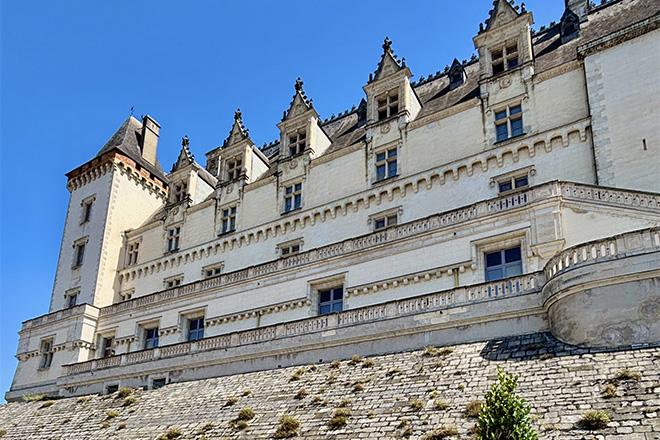
The mark of the various masters of the house (the keep of Gaston Fébus, the raising of the main buildings and roofs by Gaston IV de Foix-Béarn in the 15th century, the beautiful ornamental sculpture programme executed for Marguerite d'Angoulême and Henri d'Albret) are clearly visible, as is the complexity and irregularity of the western end, and the imposing eastern building.
There have therefore been many major transformations over the centuries, but the ancient features have been preserved and complemented by more modern additions. The history of the sovereigns who commissioned the successive works and the materiality of their achievements can be read there in the open air.
At the instigation of Prosper Mérimée, the Château de Pau was classified as a Historic Monument and appeared on the first list in 1840, which listed almost a thousand monuments, four of which were located in the Basses-Pyrénées: Lescar Cathedral, the Château Moncade in Orthez and the Church of Notre-Dame in Lembeye.
Its status as a royal residence places it outside the jurisdiction of the Commission des Monuments Historiques (Historic Monuments Commission); the architects who worked there until 1870 operated independently of its functioning and ethics.
Since the Venice Charter of 1964, the principles of reversibility and preservation of the last known state have been respected. While the stability of the interior and exterior features evokes a sometimes distant past, the interventions necessary for museum functions (public reception and safety, preservation and conservation of collections) involve the château in a sustained alternation of maintenance, repair and restoration operations, echoing Jean Latapie's warnings in 1817: ‘in order to preserve and maintain [the monument, it is necessary] to carry out annual repairs to prevent damage that would become very costly if neglected and would eventually lead to the total ruin of the building’.
À découvrir
Harmonisation paysagère de l’ancienne pépinière
Tours in English
¡Visitas comentadas del castillo en español en diciembre!