



Major projects and their challenges
Radical proposals
The visit of Napoleon I, accompanied by Empress Josephine, on 22 July 1808, highlighted the dilapidated state of the former palace of the kings of Navarre and raised the need for a complete restoration.
An official commission followed the imperial visit. A young architect who was well on his way to success, Auguste Pierre Sainte-Marie Famin, a student of Percier, was chosen over Fontaine to draw up plans for a project. His proposals were radical... their exorbitant cost discouraged the governments in 1808, but also in 1820 and 1824, when new missions were entrusted to Famin.
The 1824 project followed the Duchess of Angoulême's trip to Béarn in 1823, which had sparked renewed interest in the birthplace of Henry IV.
It was the subject of a descriptive memoir accompanied by an album of very large watercolour plates drawn by the author. The architect, winner of the Grand Prix de Rome, imagined an ideal palace, inspired by both the French Renaissance and the Florentine palaces of the Quattrocento.
Two square pavilions would have framed a monumental entrance with a semi-circular colonnade, offering a new façade overlooking the city.
These solutions, which would have involved irreparable destruction, notably that of the large brick keep built by Gaston Fébus in the 14th century, were not adopted, but they had a considerable influence on all subsequent projects, particularly in the search for an opening from the main courtyard towards the city.
This was the case with the project designed by Alexis Paccard in 1853 and the one finally carried out by Gabriel Auguste Ancelet in 1862.
The west façade or the last dreams of a palace-villa
In the late 1830s, Louis-Philippe commissioned architect Pierre-Bernard Lefranc (1795–1869), also a former student of Percier, to work on new projects for the Château de Pau.
The aim was to reverse the main entrance to the château by creating a new entrance via the park to the west.
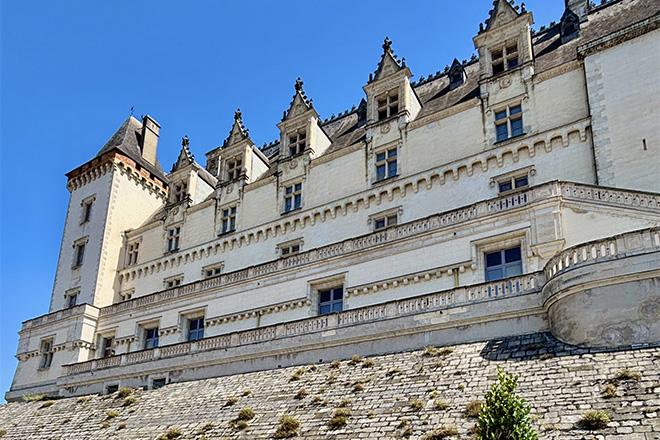
To this end, the Mazères tower, at the south-west corner of the château, was doubled with a false tower, giving symmetry to this previously very irregular end.
The project was implemented from 1843 but remained unfinished in 1848.
The grand staircase that was to complete the layout was never built, but it lent itself to several interpretations, all largely influenced by the palace-villa model dreamed up by Famin in the early 19th century.
The Second Empire preferred to focus on the western façade and the redevelopment of the main courtyard.
The regime's last architect, Auguste Lafollye (1828-1891), professed a more archaeological vision.
However, his treatment of the large south façade, completed by a neo-Renaissance pavilion, remained marked by the principles of ‘ideal’ restoration and a quest for unity that seemed illusory at the turn of the 19th and 20th centuries.
À découvrir
Harmonisation paysagère de l’ancienne pépinière
Tours in English
¡Visitas comentadas del castillo en español en diciembre!