


The Cour d’Honneur
In 1845, when landscape painter Justin Ouvrié depicted the courtyard of the Château de Pau in a small, delicately executed painting, the venerable monument was undergoing major transformation. Yet the artist bestowed upon this essential part of its architecture the colors and charm of decay and the mystery that came with it. Less than fifteen years later, an accomplished amateur, Louis-Marie-Félix Laurent-Atthalin, produced a watercolor as lively as it was precise, showing the dormer windows of the south wing, which had been restored as early as the 1850s. The chosen subject—a return from the hunt—became a favorite theme among artists and writers of all kinds, a commonplace of the Romantic universe that harmonized perfectly with the imaginative eclecticism of the forms and motifs selected by the architects.
The beautiful photograph by Alphonse Davanne, documenting the construction of the entrance portico around 1860 by Gabriel Auguste Ancelet, following the demolition of the eastern section, reveals a renewed décor that would only be completed at the beginning of the Third Republic under the supervision of Auguste Laffolye. His Plan, elevation, and section of the north façade of the south wing is imbued with the neo-Renaissance taste favored by the various architects who succeeded one another in embellishing the château during the nineteenth century.
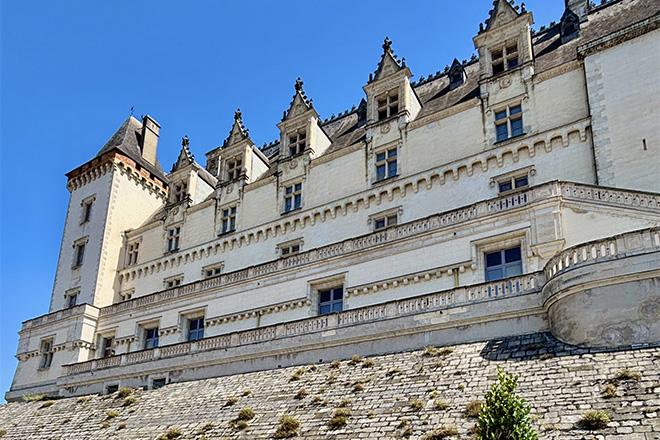
The cour d’honneur forms a major point of convergence, where the different dwellings of the former palace of the Kings of Navarre are arranged. From the late 1850s onward, historical styles were set in contrast: the flamboyant Gothic of the north wing, inspired by memories of Gaston Fébus and his successors, faces the Renaissance works of the south wing, bearing the mark of Marguerite d’Angoulême and Henri d’Albret.
The château’s architects, notably Auguste Laffolye, paid tribute here to the great figures connected to the history and restoration of the monument: the N of Napoleon III and the E of Empress Eugénie, alongside the H and M of Henri II d’Albret and Marguerite of Navarre. Rendered in brown wash highlighted with white gouache, these ornaments gracefully crown the architect’s design, while the inclusion of the landscape glimpsed beneath the south porch affirms a fundamental aesthetic principle for this imperial estate—situated in a resort town undergoing rapid tourist expansion—the unmistakable presence of the peaks of the Pyrenean range.
À découvrir
Harmonisation paysagère de l’ancienne pépinière
Tours in English
¡Visitas comentadas del castillo en español en diciembre!