



The castle of the Gastons and the Albrets
The last of the architects appointed by the Second Empire to carry out an ambitious restoration project at the Château de Pau, Joseph Auguste Lafollye (1828–1891), was not lacking in talent.
A student at the École des Beaux-Arts in Paris and winner of several prizes, he was put in charge of the imperial residences in Pau and Biarritz in 1864.
That same year, he presented drawings of the castle at the Salon and was awarded a medal.
Architect of the Palace of Compiègne in 1872, he succeeded Aymar Verdier, under the direction of Viollet-le-Duc, to continue the restoration of the sculptures of the Compiègne Town Hall and, from 1879 to 1889, took over from Eugène Millet to complete those of the Château de Saint-Germain-en-Laye.
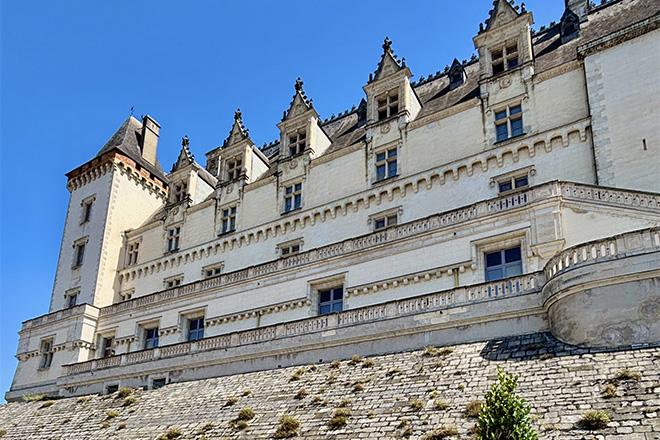
Between 1864 and 1872, at the Château de Pau, Auguste Lafollye renovated the chapel, adding two windows in the style of Henri IV, as well as the façades of the south wing, which he equipped with ramps and terraces, and the grand staircase.
The Château de Pau held an important place in the work of Auguste Lafollye, who, ten years after his assignment, dedicated a beautiful book to it, decorated with a photograph and 26 lithographed plates.
Keen to place his work in a historical and archaeological context, he looked back on the campaigns undertaken before him, offering a critical overview :
If the work had been carried out according to the method applied in Blois and Carcassonne by Duban and Viollet-le-Duc, it would have been possible to completely restore the castle of Henry II and Marguerite de Valois, which would have been even more interesting, as it would have had the particular merit of remaining a historical monument; whereas the current castle no longer belongs to history.
Auguste Lafollye nevertheless added numerous ornamental sculptures to the façades and interior decoration of the grand staircase.
Although strongly influenced by a romantic view of history, his quest for authenticity at the dawn of the Belle Époque marked a decisive change in perspective.
The castle now attained the architectural ‘status’ of a historic monument, beyond any sentimental fantasy or dynastic interest that had determined the initial restoration work:
‘Today,’ wrote Lafollye, ‘Henri IV would have difficulty finding, in the château of Louis-Philippe and Napoleon III, the room where he was born’; ‘the castle of the Gastons and the Albret’ is now lost, he lamented nostalgically.
When, in 1911, two young architects from the region, Armand Appeceix and René Pellequer, submitted four large drawings to the 1911 Salon, for its Architecture section, presenting, based on their own surveys, several aspects of the monument, their sensitivity to the setting and charm of this much-visited former royal palace was expressed in a barely modernised pastiche of the drawings published by Auguste Lafollye, who was also very attached to the appeal of the panorama of the Pyrenean peaks, as shown by his view of the Pic du Midi d'Ossau framed by the large arch of the southern porch.
À découvrir
Harmonisation paysagère de l’ancienne pépinière
Tours in English
¡Visitas comentadas del castillo en español en diciembre!